
 Open 24/7 | Call (817) 279-0582
4.9 Stars | 2,800+ Reviews
HVAC Glossary
Essential HVAC Glossary: Your Guide to Heating & Cooling Terms
- Air Handler – The indoor part of an air conditioner or heat pump that moves cooled or heated air throughout the ductwork of your home. An air handler is usually a furnace or a blower coil.
- Compressor – The part of the outdoor air conditioner or heat pump that compresses and pumps refrigerant to meet the system’s cooling requirements.
- Condenser Coil – The outdoor portion of an air conditioner or heat pump that either releases or collects heat, depending on the need. Also referred to as your outdoor coil.
- Damper – A movable plate, located in the ductwork, for regulating airflow. Dampers are used to direct air to the areas that need it most. Typically used in a zoning application.
- Dual Fuel System – A dual fuel heating and cooling system is the combination of a heat pump with a furnace (usually gas or oil). This type of system will use the heat pump to heat your home when the weather is mild, but still cold. This is more efficient than burning gas or oil. When it gets very cold, around 35ºF, the heat pump shuts down and the furnace alone heats your home. While heat pumps can heat at these lower temperatures, they are not as effective in very cold weather. In dual fuel systems, the heat pump and the furnace should not run at the same time to protect each system.
- Ductless Mini-Split – Ductless mini-split air conditioners are systems that provide cooling to one or more rooms. They incorporate the use of a condenser unit placed outside the home, with refrigerant and electrical lines that go through the exterior wall to connect to one or more compact, wall-mounted cooling units inside the home. Unlike portable or window air conditioners, ductless mini-split systems are considered a permanent fixture requiring professional installation. They are cheaper to install and less intrusive than central air, which requires a duct system. They cool only the rooms where they are located. Ductless mini-split air conditioning systems usually have one, two or more zones and in some cases, you can start small with one or two room units and grow your cooling network. Ductless mini-split systems are a good option for rooms lacking the needed space for ductwork, such as a room addition to the home or business.
- Evaporator Coil – The part of the air conditioner or heat pump located inside the air handler or attached to the furnace. Its primary function is to absorb the heat from the air in your home. Often referred to as your indoor coil.
- Furnace – A warm air system, typically fueled using propane, to deliver the heat throughout the home. The air is heated in the furnace and a blower forces it into a duct system. The warm air is then released into your home, through vents or registers in your walls, ceilings or floors.
- Geothermal – A geothermal heat pump uses the constant below ground temperature of soil or water to heat and cool your home via a system of loops. For more detailed information on how this is accomplished visit Energy.Gov
- Heat Exchanger – Located in the furnace, the heat exchanger transfers heat to the surrounding air, which is then pumped throughout the home through the duct system.
- Heat Pump – In the summer, a heat pump acts as an air conditioner through refrigeration, a heat pump can extract heat from the inside air and distributing cool air throughout your home via the ductwork. It can do this more efficiently and cleaner than any other type of system. In the winter, a heat pump is a reverse air conditioner. By reversing the flow of refrigerant and its process, it extracts heat from outside of the home and brings it inside where it is discharged through inside coil and ductwork. Heat pumps save energy because transferring heat is easier than making it. Remarkably, even when it feels cold outside, there is still a fair amount of heat to be pumped. Here in Texas, where winters are typically mild, the heat pump is sized based on your cooling needs. Therefore, it might not have enough capacity for the heating load as heat pumps become less efficient at about 35ºF. We boost its efficiency with electric strip heat to meet the heating needs of your home. This is commonly referred to as “Auxiliary” or “Emergency Heat”. Under ideal conditions, above 35ºF, a heat pump can transfer 300 percent more energy than it consumes. In contrast, a high-efficiency gas furnace is about 90 percent efficient.
- MERV – The MERV (Minimum Efficiency Reporting Value) rating of a filter describes the size of the holes in the filter that allow air to pass through. The higher the MERV rating, the smaller the holes in the filter, the higher the efficiency.
- R-22 Refrigerant – The old standard for residential air conditioners, R-22 refrigerant is now being phased out by the U.S. EPA by 2020.
- R-410A Refrigerant – A chlorine-free refrigerant that meets the EPA’s newest, most stringent environmental guidelines.
- Refrigerant – Commonly referred to as “Freon”. A chemical that produces a cooling effect while expanding or vaporizing.
- SEER – The Seasonal Energy Efficiency Ratio (SEER) is an energy efficiency rating for air conditioners. The higher the SEER, the better the energy performance, the more you save. The DOE established a minimum SEER rating for cooling of 14 in our area as of Jan. 1, 2015. Solar Ready – A term used with select air conditioners and heat pumps meaning the systems can be integrated with solar modules to supplement energy use required by the air conditioning system.
- Split System – An air conditioning and heating system in which some components are located inside the structure of the home and some are located outside. Split systems should be matched for optimal efficiency.
- Straight Electric System – A straight electric system is just that. There is no natural gas, propane, or heat pump involved. The refrigerant providing cool air to your home flows in one direction, unlike a heat pump which flows in both directions. When the system is called on for heat in the winter, heat is produced by “heat strips” in the indoor air handler. Straight electric systems are not considered as efficient as dual fuel systems or heat pumps.






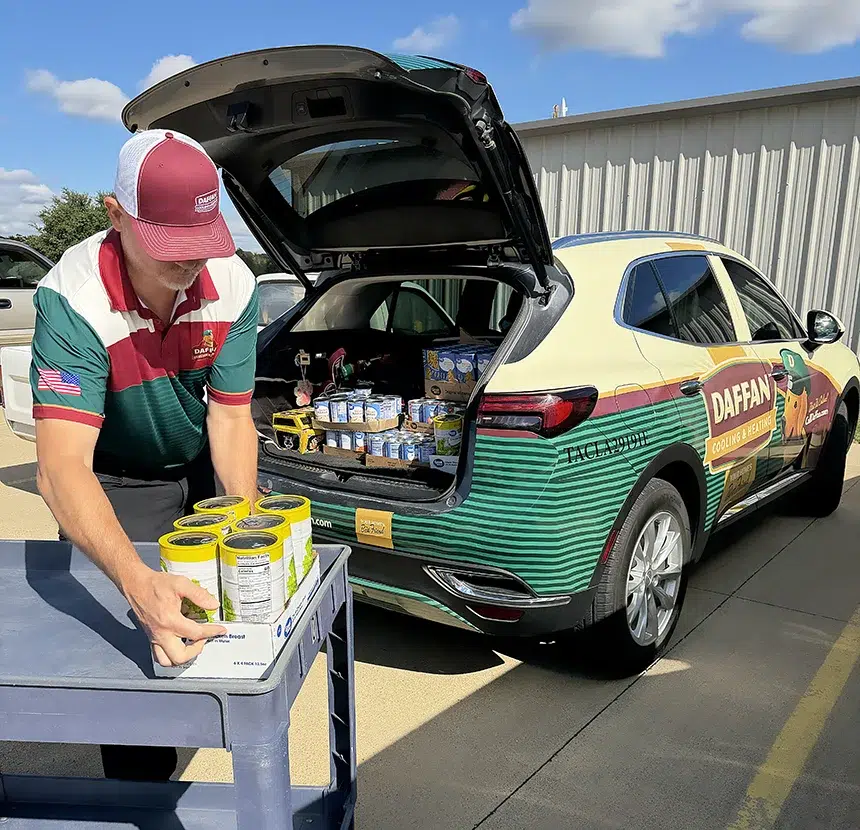


We Show Up for Our Community (and for Each Other)
Being part of this community means more than running service calls across Hood County. It means showing up for the parade, investing in our team, and genuinely caring about what happens in this town. The people who represent Daffan out in the field are the same ones celebrating together, growing together, and looking out for each other off the clock. Community starts from the inside out!
Learn More